Welcome to our websites!

2026 Best Leather Jewelry Storage Box for Wholesale Buyers

For wholesale buyers, the 2026 Leather Jewelry Storage Box market is moving beyond attractive surfaces. Retailers now expect protection, organization, branding, and dependable delivery in one product. A box should hold rings, necklaces, bracelets, and earrings without creating scratches or tangled chains. Its hinges should feel firm. Its lining should remain clean after repeated handling. Small details matter.

Jewelry business consultant Andrea Hill often emphasizes, “Packaging is part of the jewelry experience, not an afterthought.” That principle applies strongly to leather storage boxes. A carefully selected box can make a modest collection feel more valuable on a showroom counter. It can also support consistent presentation across multiple stores. For wholesale buyers, however, appearance is only one measurement. Material quality, stitching, odor, compartment design, logo placement, minimum order quantities, and lead times deserve equal attention.

This guide examines the 2026 best Leather Jewelry Storage Box options for wholesale purchasing. It considers practical use, customer expectations, and long-term supplier reliability. Some products may look impressive in photographs but disappoint during daily opening and closing. That deserves honest reflection. A darker interior may hide dust, yet it can make small earrings harder to see. A larger box may look generous, but it can increase shipping costs. The right choice depends on jewelry type, retail setting, budget, and brand identity. There is no perfect box. There is only a better fit.
2026 Best Leather Jewelry Storage Box for Wholesale Buyers

2024 Global Jewelry Market: $353.3B and 8.1% CAGR (Grand View Research)

2026 Best Leather Jewelry Storage Box for Wholesale Buyers

The global jewelry market reached $353.3 billion in 2024, according to Grand View Research. Its report projects an 8.1% compound annual growth rate through 2030. This expansion increases demand for storage that protects products and supports efficient retail presentation. Wholesale buyers should view a jewelry box as a working sales tool, not simple packaging.

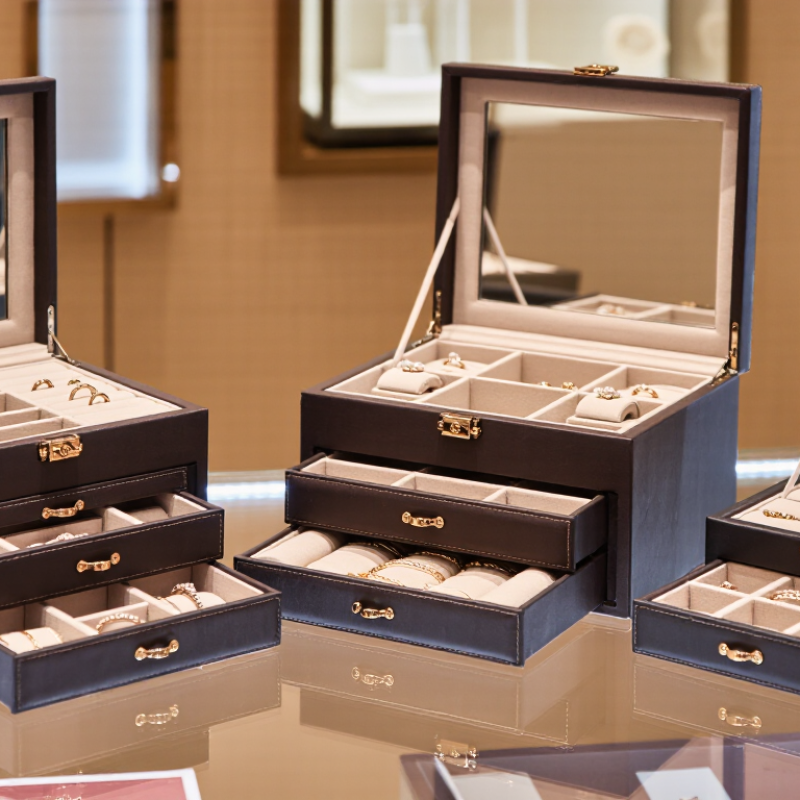
A strong leather storage box needs firm stitching, clean edges, and a stable hinge. Soft lining prevents scratches on rings, bracelets, and delicate chains. Removable trays help stores change assortments quickly. Compact dimensions also reduce shipping volume. Small details matter. A crowded interior can damage pieces and slow staff during restocking.

The World Gold Council’s Gold Demand Trends reports continued strength in jewelry consumption across major markets. That pattern supports durable, reusable presentation systems. During supplier sampling, inspect odor, color consistency, and closure strength. Request drop-test evidence and material specifications. One attractive sample proves little. I once underestimated tray depth; larger bangles did not fit properly. That mistake showed why buyers should test real inventory before placing bulk orders. Sustainability also deserves scrutiny, because “leather” may describe different materials and finishes. Clear documentation makes comparisons more reliable. Price still matters, but replacement costs can quietly erase an apparent saving.

Leather Quality Standards: ISO 2418, ASTM D1813, and Material Grading

For 2026 wholesale buyers, leather jewelry storage boxes should be evaluated beyond appearance. A smooth surface can hide weak fibers, uneven thickness, or heavy finishing. ISO 2418 helps define where leather samples should be taken for testing. This matters because one small edge may not represent the entire hide. Ask suppliers to identify the sampling location and batch number clearly.

ASTM D1813 measures leather thickness. It does not prove durability, softness, or long-term performance. For storage boxes, compare readings across the lid, base, and wrapped edges. Uneven measurements may cause loose corners or poor fitting. A practical inspection should include bending, stitching checks, and rubbing tests with a dry cloth. Small details matter.

Material grading also requires caution. Full-grain, corrected-grain, and split leather describe different surface and fiber conditions, but terminology can vary between suppliers. A higher grade is not automatically better for every box design. I have seen attractive samples fail when thin leather was stretched over rigid panels. That mistake is easy to overlook. Buyers should request material descriptions, thickness records, test reports, and pre-production samples. Keep these documents with the purchase file. Standards guide decisions, but careful verification still protects quality.

2026 Best Leather Jewelry Storage Box for Wholesale Buyers - Leather Quality Standards: ISO 2418, ASTM D1813, and Material Grading

Quality Dimension Applicable Standard or Classification Verified Requirement or Industry Definition Recommended Wholesale Buying Benchmark Verification Method and Buyer Record
Sample location and preparation ISO 2418
Leather specimen location and preparation
ISO 2418 establishes principles for selecting the location and preparing specimens used for leather chemical, physical, mechanical, and fastness tests. It is a sampling and specimen-preparation standard; it is not a finished-product grade. Use a documented sampling plan covering the hide area, visible grain, edges, seams, and randomly selected finished boxes. Keep the sample location and batch number with the test report. Request the specimen map, batch identification, conditioning information, and laboratory report. Do not compare results from differently prepared specimens without checking the method.
Leather thickness ASTM D1813
Thickness of leather
ASTM D1813 is a standard test method for measuring leather thickness. Thickness is normally reported in millimetres or inches. The method does not set a universal “premium” thickness for jewelry boxes. Typical buyer specification for a leather-covered box panel: 0.8–1.2 mm for flexible cover leather, or a separately specified construction when leather is laminated to a board or synthetic substrate. This is a purchasing benchmark, not an ASTM limit. Measure multiple points on conditioned specimens using equipment and procedures conforming to ASTM D1813. Record the mean, minimum, maximum, test locations, and tolerance agreed in the purchase order.
Leather material category Industry material description Full-grain: original grain surface retained.
Top-grain: upper grain layer used, usually with some surface treatment or light correction.
Corrected-grain: surface mechanically altered or embossed to reduce natural marks.
Split: a lower layer separated from the original hide.
State the category explicitly in the specification. For a premium appearance, request full-grain or top-grain leather; accept corrected-grain or split leather only when the finish, durability, and price position are approved. Review the supplier’s material declaration, cross-section photographs, and physical sample. A surface appearance alone cannot reliably identify the leather category.
Material grading Buyer-defined grading system There is no single universal global A/B/C grading system that defines leather quality for every tannery or finished product. “Grade” must be linked to measurable attributes and agreed defect limits. Use a written grade matrix: Grade A = consistent color and grain with no visible defects on customer-facing panels; Grade B = minor non-structural variation allowed outside focal areas; Reject = cracks, peeling, exposed substrate, deep scars, or stains visible at normal viewing distance. Approve a sealed reference sample, defect photographs, viewing distance, lighting conditions, and an acceptance limit before mass production. Keep an inspection report for each production lot.
Surface appearance Visual acceptance specification Natural leather can show grain variation, pores, color variation, and minor healed marks. These characteristics are not automatically defects, while cracking, flaking, exposed backing, and unstable coating indicate functional or finishing problems. Customer-facing surfaces should be free from open cracks, peeling finish, deep scratches, glue marks, wrinkles that affect the box shape, and obvious color mismatch within one set. Inspect under neutral white light at a practical viewing distance of approximately 50–60 cm. Compare with the approved color and texture standard.
Color consistency Color-control specification Color can vary because of hide selection, dyeing, finishing, lighting, and screen display. A visual sample is necessary even when a color name or code is provided. Require one approved master sample and define acceptable variation across the lid, base, compartments, and matching sets. For large programs, use instrumental color tolerances only when both parties agree on the color system and measurement conditions. Check production samples against the master sample under the same light source. Record lighting conditions and whether the comparison is visual or instrumental.
Bonding and lamination Finished-product workmanship requirement ASTM D1813 measures thickness; it does not verify adhesive bond strength. Leather jewelry boxes commonly combine leather with board, foam, wood, metal, or textile components, so the adhesive interface requires separate inspection. No lifting, bubbling, loose corners, adhesive bleed-through, or visible gaps on customer-facing areas. Edges should remain bonded after normal opening and closing of the lid. Perform visual inspection and a controlled edge or seam check on samples. Define any destructive bond test separately in the purchase specification.
Flexibility and handling Application-specific performance requirement Leather flexibility depends on tannage, finishing, thickness, backing, temperature, and construction. ISO 2418 supports specimen preparation but does not establish a universal flexibility limit for jewelry boxes. The cover should conform smoothly around corners without whitening, cracking, or permanent distortion. Hinges and folds should operate without pulling the leather away from the substrate. Inspect a representative sample through repeated opening and closing. Record the number of cycles and the conditions used in the buyer’s internal test.
Odor and chemical compliance Market and buyer compliance requirement Leather odor and chemical performance are not determined by ASTM D1813. Requirements depend on the destination market, applicable regulations, restricted-substance lists, and the materials used in the complete box. Require a material declaration for leather, dyes, coatings, adhesives, foam, lining, and metal fittings. Reject persistent solvent, mold, or strong chemical odors in finished goods. Request relevant third-party or supplier test reports when required by the destination market. Test the complete assembled product when component interaction may affect odor or compliance.
Lining and jewelry contact surface Product-construction specification The lining is a separate material and should not be assumed to have the same quality or composition as the outer leather. Softness, linting, dye transfer, and abrasion resistance are important for jewelry contact. Use a smooth, low-lint lining with secure stitching or bonding. It should not shed fibers, transfer visible color, or create rough contact points that may scratch jewelry. Inspect lining seams, corners, and contact areas. Conduct a dry and damp color-transfer check when the jewelry type and destination market make it necessary.
Lot consistency for wholesale orders Purchase-order control Leather is a natural material, so hide-to-hide variation is expected. Consistency is controlled through material approval, batch identification, and defined acceptance criteria rather than by relying only on a grade name. Approve a pre-production sample and retain a golden sample. Specify acceptable variation for color, grain, thickness, dimensions, stitching, hardware, and packaging before production begins. Use lot-based inspection with a documented sampling level agreed by the buyer and supplier. Separate nonconforming units and record corrective action.

Important purchasing note: ISO 2418 and ASTM D1813 are test-related standards and do not by themselves certify a leather jewelry storage box as “premium.” A reliable wholesale specification should identify the leather category, measurable thickness, visible-defect limits, construction requirements, sampling plan, and destination-market compliance requirements.

Storage Performance: 40–50% RH, Tarnish Control, and Lining pH

2026 Best Leather Jewelry Storage Box for Wholesale Buyers

For wholesale buyers, storage performance is a measurable feature, not decorative language. A leather jewelry box should support a stable 40–50% relative humidity environment. The Canadian Conservation Institute recommends moderate, stable humidity for leather objects, often near 45–55% RH. Stability matters more.

At 40–50% RH, silver and copper alloys still need protection from sulfur compounds, moisture, and skin residues. The National Park Service Museum Handbook identifies sulfur pollutants as major tarnish accelerators. Therefore, a box should use low-emission materials, tight seams, and a clean internal barrier. Do not promise zero tarnish. That claim is unrealistic. A removable anti-tarnish insert may help, but its service life needs testing.

Lining pH deserves equal attention. Suppliers should request pH test results for velvet, microfiber, foam, and adhesive layers. A near-neutral lining, approximately pH 6.5–7.5, reduces the risk of acidic contact with plated surfaces and leather. The pH range is not a complete safety certificate. Dyes, plasticizers, and adhesive vapors can still cause problems. The Getty Conservation Institute reports that material interactions often depend on humidity, pollutants, and contact time. For sampling, buyers can inspect a sealed box after 30 days with silver test coupons. Check odor, color transfer, condensation, and clasp discoloration. One weakness remains: real shipping conditions are harsher than showroom tests.

Wholesale Metrics: MOQ, Unit Cost, Carton Cube, and Defect Rate

2026 Best Leather Jewelry Storage Box for Wholesale Buyers

Wholesale buyers should compare four numbers before admiring the leather finish: MOQ, unit cost, carton cube, and defect rate. A practical starting MOQ is 300 units, especially for custom colors or logos. At this volume, a compact leather jewelry box may cost about $4.80–$9.50 per unit, depending on lining, hinges, and hand-finishing. Treat these figures as negotiation benchmarks, not fixed market prices.

Carton cube affects freight more than many buyers expect. For example, twelve boxes packed in a 30 × 24 × 18 cm carton occupy 0.01296 cubic meters. Request the packed dimensions, not only the product size. Packaging research from Smithers highlights material efficiency and transport reduction as growing purchasing priorities. A thinner foam insert can save space, but it may increase scratches. That trade-off needs physical testing.

Defect control requires clearer language. ISO 2859-1 sampling procedures are widely used for acceptance inspection, while AQL 2.5 is an inspection level, not a guaranteed 2.5% defect rate. For wholesale storage boxes, set separate limits for surface marks, loose stitching, odor, hardware failure, and crushed corners. A reasonable internal target is below 1% major defects, with cosmetic defects tracked separately. I would still inspect at least one carton from every production batch. Supplier photos often miss uneven edges. Sometimes, the “best” unit cost creates the most expensive rework.

2026 Supplier Selection: Compliance Audits and Total Landed Cost

For wholesale buyers, a leather jewelry storage box should pass a supplier audit before it passes a design review. Check factory registration, worker safety, material traceability, and quality records. Request evidence for leather composition, dyes, adhesives, metal fittings, and packaging materials. Country-specific import rules still apply. Do not guess.

The 2023 World Bank Logistics Performance Index assessed 139 economies across customs, infrastructure, shipment quality, and timeliness. These factors can change delivery risk more than a low unit price. The 2024 UNCTAD Review of Maritime Transport reports that over 80% of global merchandise trade moves by sea. Therefore, audit the supplier’s export experience, carton strength, labeling process, and document accuracy. A polished sample means little if cartons arrive damaged or declarations need correction.

Calculate total landed cost, not just the factory quotation. Include product price, tooling, inspection, inland transport, ocean or air freight, insurance, duties, customs fees, storage, and expected defect losses. A simple audit sheet helps compare suppliers fairly. Add a five percent contingency for uncertain freight or rework, then challenge that assumption. It may be too low. It may also hide poor planning. For leather boxes, inspect stitching tension, edge paint, odor, hinge alignment, and velvet cleanliness across multiple production batches. Small details matter. Reliable suppliers welcome evidence-based questions.

2026 Best Leather Jewelry Storage Box for Wholesale Buyers

Supplier Selection: Compliance Audits and Total Landed Cost

Planning benchmark: The chart estimates total landed cost at US$11.20 per unit for a 1,000-unit ocean shipment of non-branded leather jewelry storage boxes. The model includes product and packaging, international freight and insurance, import duty, customs handling, and inland delivery. Before placing an order, verify the destination country’s tariff classification, duty rate, documentation requirements, restricted-substance testing, social compliance, and product safety records.